Trees on school and business sites
Trees on sites with public access
The Short Answer
Responsibility for trees rests with whoever occupies or controls the land they stand on. For a school that usually means the trust, governing body or local authority that runs the site. For a business it means the occupier, which may be the freeholder or the leaseholder, depending on the lease. The duty is to take reasonable care that trees do not injure people or damage property.
It does not pass to the tree surgeon who last worked on the tree, and it does not pass to the insurer. What insurers and, if it ever comes to it, courts want to see is evidence that the risk was looked at, judged sensibly and acted on.
Why Sites With Public Access Are Different
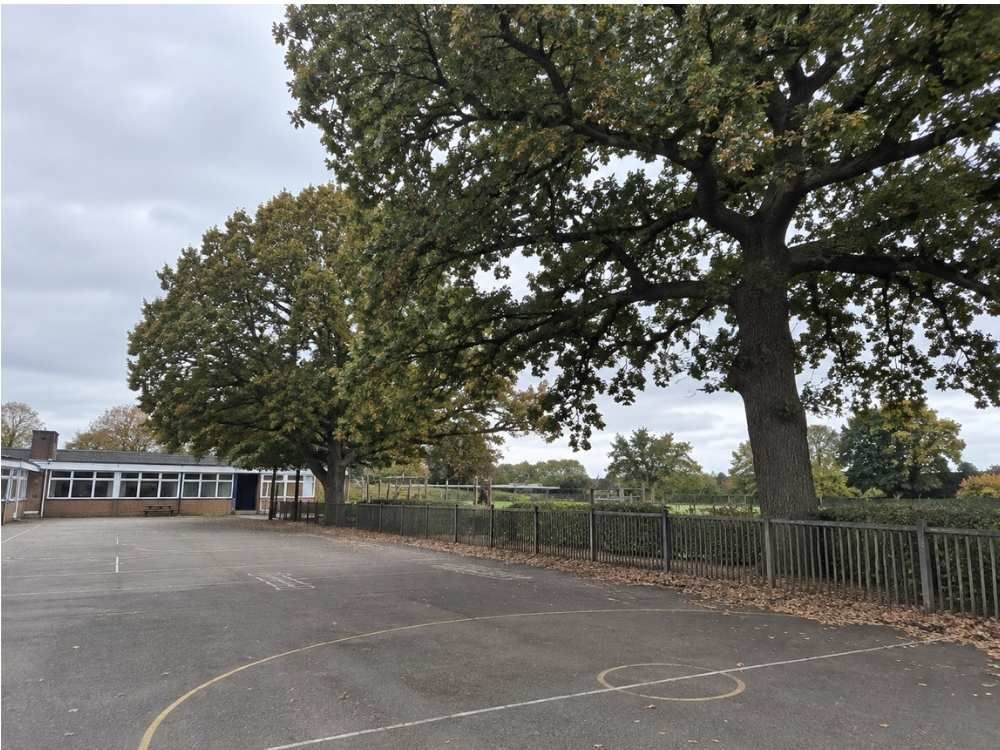
A tree's risk is a product of how likely it is to fail and what is underneath it when it does. On a school or business site the second half of that equation is much higher than in a private garden.
- Playgrounds and outdoor teaching areas, occupied by large numbers of people at predictable times.
- Car parks, where vehicles sit under trees all day.
- Footpaths, entrances and pick-up points, used by everyone arriving and leaving.
- Beer gardens, seating and smoking areas, occupied most in exactly the summer weather that follows dry spells and precedes summer storms.
- Boundaries with neighbours and highways, where a failure lands on someone else's property.
The same tree in the middle of a playing field barely registers. That difference is what a proportionate approach is built on: concentrate effort where people are.
How Often Should Site Trees Be Checked?
There is no statutory interval, and anyone quoting one is inventing it. The widely used guidance from the National Tree Safety Group is to match the frequency to the risk. In practice most sites land on something like this:
- Trees over playgrounds, car parks, paths and boundaries: a look at least annually, ideally in leaf and again in winter when the structure is visible.
- After any major storm, a walk round to spot hanging limbs, new leans and lifting soil.
- Trees away from people and property: far less often, and often not at all.
Whoever does it does not have to be a specialist for a routine walk round. What matters is that someone competent looks, that anything concerning gets assessed properly, and that the whole thing is recorded.
Keeping Records That Are Worth Something
A usable record is not complicated. For each check, note the date, who did it, which trees were looked at, what was found and what was decided, with a few photographs. Keep quotes and invoices for any work with it.
The value only shows up later. If a limb comes down on a car, the difference between "we keep an eye on them" and a dated file showing the tree was checked eight months ago, nothing was wrong then, and the work recommended was carried out, is the difference between a defensible position and an awkward one.
Boundaries, Highways and Neighbours
Overhanging a Public Road or Path
Trees on your land overhanging a public highway remain your responsibility, and the highway authority can require them to be cut back to maintain clearance. Trees on council land are the council's.
Next Door's Tree Over Your Car Park
You may generally cut overhanging growth back to the boundary line, but no further, and the cuttings belong to the tree's owner. If you believe a neighbour's tree is actually dangerous, raise it in writing. That record matters to both sides.
Protected Trees
Many trees on older school and commercial sites carry a Tree Preservation Order, or sit in a conservation area where six weeks' notice applies. Work that is urgently necessary to remove an immediate danger is a narrow exception, and photographs taken beforehand are what justify relying on it.
Checking the Contractor
Before work starts on a site with public access, ask for three things: public liability insurance, evidence of NPTC qualifications for the people doing the cutting, and a written quote. For construction sites, CSCS cards are usually expected as well. If a formal tree survey to BS 5837 is needed for a planning application, that comes from a consulting arboriculturist rather than a tree surgeon.
This is general information rather than legal advice. Leases, trust arrangements and insurance policies vary, and yours decide the position on your site.
Responsible for trees on a school, business or managed site in Colchester or north Essex? We work with schools, agents, estates and site managers on inspections, maintenance and removals, scheduled around your quietest times, with written quotes and council applications handled free of charge.
See commercial tree surgery in Colchester, or send photos and a site list for a provisional figure.